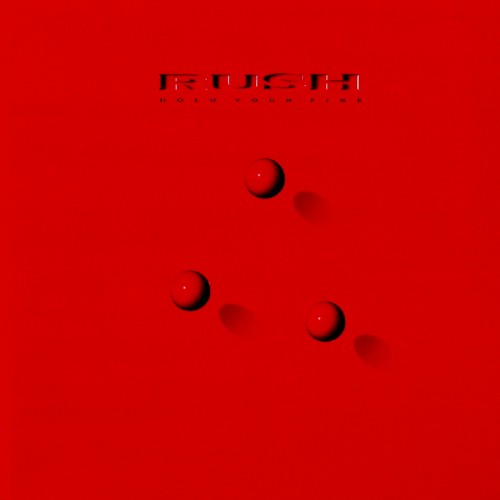
The sleeve is examined as evidence, not decoration. Three glossy spheres sit
in a loose triangle on an unbroken red field, each lit from the upper left and
casting a soft shadow to the lower right. They are spaced apart and stationary
— arranged rather than in motion. The title’s instruction is rendered before
a single note is heard: objects held in position, not released.
Hold your fire is language issued to someone who is already armed and already aiming. It does not ask whether force exists. It assumes force exists, assumes the capacity to release it, and instructs the holder to wait. The album is named for the moment before discharge.
That distinction runs through the record. These ten tracks are not about the absence of power. They are about power under restraint — reaction withheld, ambition contained, emotion recognised rather than obeyed. The album asks a question the catalogue has been circling since 2112: who is holding the trigger, and on whose instruction?
Case Summary
Album decode: Control your own force — reaction, ambition, emotion, violence, mission, and memory.
Every exhibit below is drawn directly from the archive. Ten of ten tracks are documented and dated; none are flagged. The recurring motif set across all ten is identical: traveler, agency, discernment. That uniformity is itself evidence. The album does not wander between concerns. It circles one.
Listen alongsideThe album in release order — the sequence the exhibits follow.
Hosted on YouTube by a third party and embedded here for reference. Not affiliated with the artist or label. If the playlist goes dark, that is YouTube’s doing, not ours.
Exhibits
EXHIBIT HYF.1Force TenIWL
Look in, look out, look around. Awareness is the first response to pressure.
The album opens at maximum measurable force — and the instruction is not to act but to observe. Before the record asks anything to be held, it asks for the direction of attention.
Motifs
traveler, agency, discernment
Released
1987
Confidence
Documented
EXHIBIT HYF.2Time Stand StillIWL
The Inside War is against speed. Experience slips away when attention is lost.
The archive names this one explicitly. Not an enemy outside the self — the war is against velocity, and the casualty is what went unnoticed while moving.
Motifs
traveler, agency, discernment
Released
1987
Confidence
Documented
EXHIBIT HYF.3Lock and KeyIWL
The primitive self must be recognised and contained. Freedom requires self-control.
The most direct statement of the album's title. Something is locked. The record does not claim the thing behind the lock has been eliminated — only that it has been acknowledged and held.
Motifs
traveler, agency, discernment
Released
1987
Confidence
Documented
EXHIBIT HYF.4MissionIWL
A spirit with a vision is a dream with a mission, but obsession can burn.
The exhibit refuses to celebrate drive without qualification. Vision and obsession are shown as the same fuel at different temperatures. The album's instruction applies here too.
Motifs
traveler, agency, discernment
Released
1987
Confidence
Documented
EXHIBIT HYF.5Prime MoverIWL
The point of the journey is not to arrive. You set the wheels in motion.
The traveler motif surfaces in its clearest form. Note the second sentence: agency is asserted, not assumed. Someone sets the wheels moving. The exhibit leaves open who.
Motifs
traveler, agency, discernment
Released
1987
Confidence
Documented
EXHIBIT HYF.6Second NatureIWL
No one is blameless. Responsibility is not accusation; it is participation in repair.
The record turns outward without turning to blame. The distinction drawn here — responsibility separated from accusation — is one the catalogue returns to repeatedly.
Motifs
traveler, agency, discernment
Released
1987
Confidence
Documented
EXHIBIT HYF.7Open SecretsIWL
What remains hidden keeps us from growing. Understanding requires lowered barriers.
A counter-weight to Lock and Key. One exhibit argues for containment; this one argues for opening. The album holds both without resolving them — the reader is left to judge which applies where.
Motifs
traveler, agency, discernment
Released
1987
Confidence
Documented
EXHIBIT HYF.8Tai ShanIWL
Ancient landscape restores perspective and humility.
The traveler leaves the argument entirely and stands on a mountain older than the question. Scale is offered as a corrective.
Motifs
traveler, agency, discernment
Released
1987
Confidence
Documented
EXHIBIT HYF.9High WaterIWL
Water returns us to origin, memory, and the source beneath the self.
The album's deepest downward move. Beneath reaction, ambition and emotion, the exhibit locates something older than all three.
Motifs
traveler, agency, discernment
Released
1987
Confidence
Documented
EXHIBIT HYF.10Turn the PageIWL
Truth moves; growth means turning the page.
The record closes on motion rather than conclusion. Nothing is settled. The instruction is to continue reading.
Motifs
traveler, agency, discernment
Released
1987
Confidence
Documented
Closing Statement
Ten exhibits, one instruction. The album does not argue that force is wrong — it argues that force released without discernment is not strength but reaction. Lock and Key contains; Open Secrets releases. The record declines to say which is correct, and that refusal is the finding.
What the chronology records is the question, not the answer: who gave the order to hold?
Case remains open
Rediscover
On the next listen, play Lock and Key directly into Open Secrets. One exhibit argues for containment and the next for opening. Ask whether the album is contradicting itself — or teaching you to tell the two situations apart.
The complete investigation
This case is one of 20 in the Rush file — the full catalogue from the 1974 debut through Clockwork Angels, examined in release order.