
How to read this archive
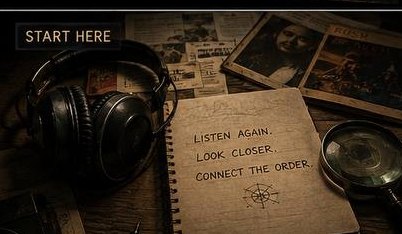
Listen again. Look closer.
Connect the order.
Nothing here asks you to take a claim on faith. Every reading names what it is built on, and the evidence stays visible underneath the interpretation so you can disagree with the conclusion without losing the facts.
The one idea
A catalogue heard album-by-album is a set of records. The same catalogue heard in release order is a sequence — and sequences do something individual albums cannot. Speakers recur. Guides change. A question asked early gets answered, or inverted, decades later. That is the whole premise: the songs never changed, the order does.
Four ways in
One
Read a single case file
Start with Hold Your Fire (Rush, 1987). It shows the method at full length on one record — documented facts, what is observable in the work, and where interpretation begins.
Two
Walk an investigation
Five rooms: Rush, Genesis, The Police, Journey, and The Deal. Each takes a catalogue in order rather than by reputation.
Three
Trace a symbol
Follow one motif across artists who never worked together. The index is deliberately conservative — it shows how few symbols genuinely travel, which is more interesting than a long list would be.
Four
Browse the raw decodes
1,213 songs, each with its reading. No narrative, no argument — just the archive as it stands.
How evidence is labelled
The method’s credibility depends on never letting an interpretation look like a documented fact. Six tiers, always named in text, never signalled by colour alone.
- Documented record — verified dates, credits, track order, packaging, authenticated interviews.
- Observed in the work — a word, sound, image or structural change present in the artifact.
- Intra-catalogue recurrence — a motif that repeats or evolves within one artist’s chronology.
- IWL interpretation — a speaker assignment or transaction reading. A conclusion, not a fact.
- Cross-catalogue convergence — a comparable pattern across artists. Evidence of recurrence, not proof of coordination.
- Speculative extension — synthesis built from the pattern. Never presented as a case finding.
What this is not
It is not a claim that artists coordinated. It is not biography. It is not a search for hidden messages in reverse. Recurrence across catalogues is documented where it appears and labelled as recurrence — the archive keeps its own rebuttals on file, including readings that were tested and formally limited.
The Devil’s Den exhibit includes deliberate negative controls: songs that name the Devil but record no transaction, kept in the collection precisely to stop the pattern proving itself.